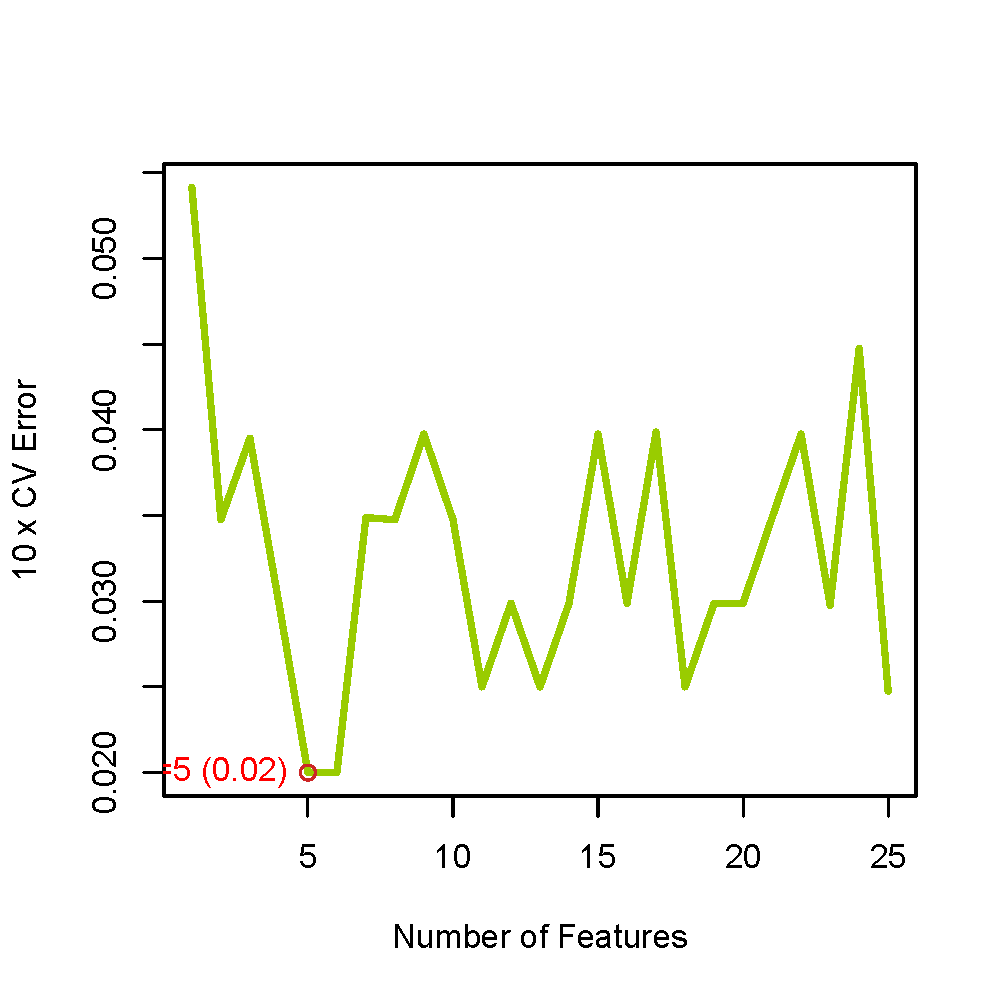
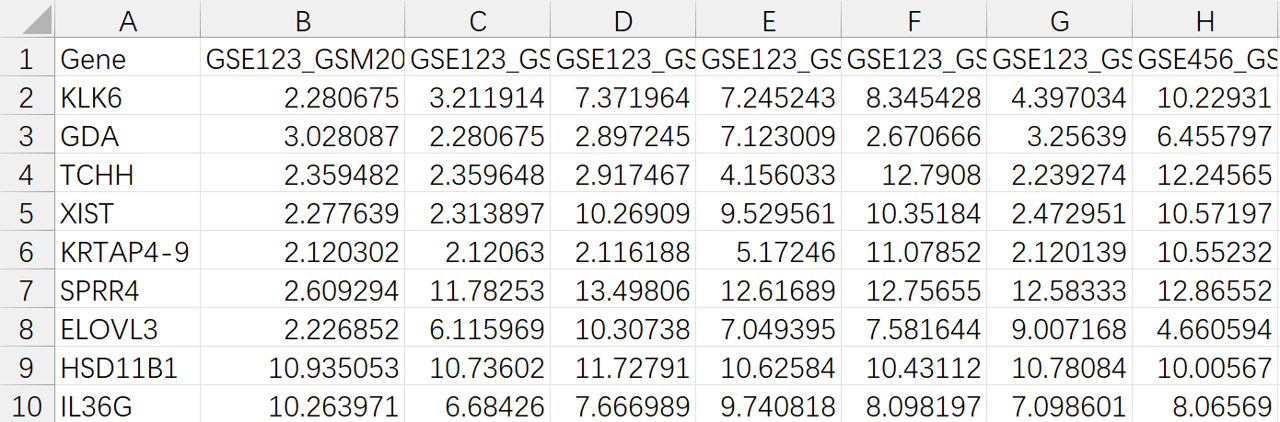
#======================================
# 原创代码无删减,编写不易,论文使用本代码绘图,请引用:www.tcmbiohub.com

# 祝大家投稿顺利!

#脚本一,单独另存为.R格式
#============================
# Copyright (C) 2011 John Colby
# http://github.com/johncolby/SVM-RFE
# Revised for stable use in all-gene SVM-RFE workflows

svmRFE.wrap <- function(test.fold, X, ...) {
  # Wrapper to run svmRFE function while omitting a given test fold
  train.data <- X[-test.fold, , drop = FALSE]
  test.data  <- X[test.fold, , drop = FALSE]

  # Rank the features
  features.ranked <- svmRFE(train.data, ...)

  return(list(
    feature.ids = features.ranked,
    train.data.ids = row.names(train.data),
    test.data.ids = row.names(test.data)
  ))
}

svmRFE <- function(X, k = 1, halve.above = 5000) {
  # Feature selection with Multiple SVM Recursive Feature Elimination (RFE) algorithm

  n <- ncol(X) - 1

  if (n < 1) {
    stop("No feature columns found in X. The first column must be group labels, and the rest must be features.")
  }

  # Scale data up front so it doesn't have to be redone each pass
  cat("Scaling data...")
  X[, -1] <- scale(X[, -1])
  cat("Done!\n")
  flush.console()

  pb <- txtProgressBar(min = 1, max = n, initial = 1, style = 3)

  i.surviving <- 1:n
  i.ranked <- n
  ranked.list <- vector(mode = "numeric", length = n)

  # Recurse through all the features
  while (length(i.surviving) > 0) {

    if (k > 1) {
      # Subsample to obtain multiple weights vectors (i.e. mSVM-RFE)
      folds <- rep(1:k, length.out = nrow(X))[sample(nrow(X))]
      folds <- lapply(1:k, function(x) which(folds == x))

      # Obtain weights for each training set
      w <- lapply(folds, getWeights, X[, c(1, 1 + i.surviving), drop = FALSE])
      w <- do.call(rbind, w)

      if (is.vector(w)) {
        w <- matrix(w, nrow = 1)
      }

      # Normalize each weights vector
      w <- t(apply(w, 1, function(x) {
        denom <- sqrt(sum(x^2))
        if (denom == 0 || is.na(denom)) {
          rep(0, length(x))
        } else {
          x / denom
        }
      }))

      # Compute ranking criteria
      v <- w * w
      vbar <- apply(v, 2, mean)
      vsd <- apply(v, 2, sd)
      vsd[is.na(vsd) | vsd == 0] <- 1e-12
      cval <- vbar / vsd

    } else {
      # Only do 1 pass (i.e. regular SVM-RFE)
      w <- getWeights(NULL, X[, c(1, 1 + i.surviving), drop = FALSE])
      cval <- as.vector(w * w)
    }

    # Rank the features: smaller criterion removed first
    ranking <- sort(cval, index.return = TRUE)$ix
    if (length(i.surviving) == 1) {
      ranking <- 1
    }

    if (length(i.surviving) > halve.above) {
      # Cut features in half until less than halve.above
      nfeat <- length(i.surviving)
      ncut <- round(nfeat / 2)
      nleft <- nfeat - ncut

      cat("Features halved from", nfeat, "to", nleft, "\n")
      flush.console()

      pb <- txtProgressBar(min = 1, max = max(1, nleft), initial = 1, style = 3)
    } else {
      ncut <- 1
    }

    # Update feature list
    ranked.list[i.ranked:(i.ranked - ncut + 1)] <- i.surviving[ranking[1:ncut]]
    i.ranked <- i.ranked - ncut
    i.surviving <- i.surviving[-ranking[1:ncut]]

    current_done <- n - length(i.surviving)
    setTxtProgressBar(pb, max(1, min(current_done, n)))
    flush.console()
  }

  close(pb)
  return(ranked.list)
}

getWeights <- function(test.fold, X) {
  # Fit a linear SVM model and obtain feature weights
  train.data <- X
  if (!is.null(test.fold)) {
    train.data <- X[-test.fold, , drop = FALSE]
  }

  svmModel <- svm(
    x = train.data[, -1, drop = FALSE],
    y = train.data[, 1],
    cost = 10,
    cachesize = 500,
    scale = FALSE,
    type = "C-classification",
    kernel = "linear"
  )

  w <- t(svmModel$coefs) %*% svmModel$SV
  return(as.vector(w))
}

WriteFeatures <- function(results, input, save = TRUE, file = "features_ranked.txt") {
  # Compile feature rankings across multiple folds

  rank.matrix <- sapply(results, function(x) {
    sort(x$feature.ids, index.return = TRUE)$ix
  })

  if (is.vector(rank.matrix)) {
    rank.matrix <- matrix(rank.matrix, ncol = 1)
  }

  avg.rank <- apply(rank.matrix, 1, mean)
  ord <- sort(avg.rank, index.return = TRUE)

  featureID <- ord$ix
  avg.rank.sorted <- ord$x
  feature.name <- colnames(input[, -1, drop = FALSE])[featureID]

  features.ranked <- data.frame(
    FeatureName = feature.name,
    FeatureID = featureID,
    AvgRank = avg.rank.sorted,
    stringsAsFactors = FALSE
  )

  if (save) {
    write.table(features.ranked, file = file, quote = FALSE, row.names = FALSE, sep = "\t")
  } else {
    return(features.ranked)
  }
}

FeatSweep.wrap <- function(i, results, input) {
  # Wrapper to estimate generalization error across all hold-out folds,
  # for a given number of top features

  svm.list <- lapply(results, function(x) {
    out <- tryCatch({
      train.x <- input[x$train.data.ids, 1 + x$feature.ids[1:i], drop = FALSE]
      train.y <- input[x$train.data.ids, 1]
      test.x  <- input[x$test.data.ids, 1 + x$feature.ids[1:i], drop = FALSE]
      test.y  <- input[x$test.data.ids, 1]

      # Step 1: inner tuning on training set only
      best.par <- tune(
        svm,
        train.x = train.x,
        train.y = train.y,
        ranges = list(gamma = 2^(-12:0), cost = 2^(-6:6))
      )$best.parameters

      # Step 2: evaluate on fixed validation set
      fit <- svm(
        x = train.x,
        y = train.y,
        gamma = best.par$gamma,
        cost = best.par$cost
      )

      pred <- predict(fit, test.x)
      err <- mean(pred != test.y)

      data.frame(error = err)
    }, error = function(e) {
      data.frame(error = NA_real_)
    })

    return(out)
  })

  err.vec <- sapply(svm.list, function(x) x$error)
  error <- mean(err.vec, na.rm = TRUE)

  if (is.nan(error)) {
    error <- NA_real_
  }

  return(list(svm.list = svm.list, error = error))
}

PlotErrors <- function(errors, errors2 = NULL, no.info = 0.5,
                       ylim = range(c(errors, errors2), na.rm = TRUE),
                       xlab = "Number of Features", ylab = "10 x CV Error") {
  # Makes a plot of average generalization error vs. number of top features

  AddLine <- function(x, col = "#99CC00FF") {
    idx <- which(!is.na(x))
    if (length(idx) == 0) return(NULL)

    lines(idx, x[idx], col = col, lwd = 3)
    points(which.min(x), min(x, na.rm = TRUE), col = "firebrick3")
    text(
      which.min(x),
      min(x, na.rm = TRUE),
      paste0("n=", which.min(x), " (", format(min(x, na.rm = TRUE), digits = 3), ")"),
      pos = 2,
      col = "red",
      cex = 1
    )
  }

  plot(seq_along(errors), errors, type = "n", ylim = ylim, xlab = xlab, ylab = ylab)
  AddLine(errors)
  if (!is.null(errors2)) AddLine(errors2, "gray30")
  abline(h = no.info, lty = 2)
}

Plotaccuracy <- function(errors, errors2 = NULL, no.info = 0.5,
                         ylim = range(c(errors, errors2), na.rm = TRUE),
                         xlab = "Number of Features", ylab = "10 x CV Accuracy") {
  # Makes a plot of average generalization accuracy vs. number of top features

  AddLine <- function(x, col = "#99CC00FF") {
    idx <- which(!is.na(x))
    if (length(idx) == 0) return(NULL)

    lines(idx, x[idx], col = col, lwd = 3)
    points(which.max(x), max(x, na.rm = TRUE), col = "firebrick3")
    text(
      which.max(x),
      max(x, na.rm = TRUE),
      paste0("n=", which.max(x), " (", format(max(x, na.rm = TRUE), digits = 3), ")"),
      pos = 2,
      col = "red",
      cex = 1
    )
  }

  plot(seq_along(errors), errors, type = "n", ylim = ylim, xlab = xlab, ylab = ylab)
  AddLine(errors)
  if (!is.null(errors2)) AddLine(errors2, "gray30")
  abline(h = no.info, lty = 2)
}


#单独的脚本结束


#脚本二,单独另存为.R格式,准备好之后,只需要运行脚本二即可

##############################
## SVM-RFE 最终定向版(优化完整版)
## 目的:
## 1. 对 merge.Top1000.variance.txt 进行 SVM-RFE
## 2. 放宽筛选,避免最终基因数过少
## 3. 最终结果必须包含 genename
## 4. 输出错误率图和准确率图
## 5. 将特征评估上限限制为25,避免过度扫描
## 6. 只输出 1 个最终基因txt文件
##############################

##############################
## 0. 环境准备
##############################
.libPaths(c(Sys.getenv("R_LIBS_USER"), .libPaths()))
options(stringsAsFactors = FALSE)

suppressPackageStartupMessages({
  library(limma)
  library(e1071)
})

##############################
## 1. 文件与目录
##############################
expFile <- "merge.Top1000.variance.txt"
setwd("C:/Users/Administrator/Desktop/6.机器学习/2.SVM")

source("AI21.msvmRFE.R")

target_genes <- c("genename1", "genename2", "genename3")
force_include_target <- TRUE

##############################
## 2. 读取表达矩阵
##############################
rt <- read.table(
  expFile,
  header = TRUE,
  sep = "\t",
  check.names = FALSE,
  stringsAsFactors = FALSE,
  quote = "",
  comment.char = ""
)

rt <- as.matrix(rt)
rownames(rt) <- rt[, 1]

exp <- rt[, 2:ncol(rt), drop = FALSE]

dimnames_list <- list(rownames(exp), colnames(exp))
data <- matrix(
  as.numeric(as.matrix(exp)),
  nrow = nrow(exp),
  dimnames = dimnames_list
)

data <- avereps(data)

##############################
## 3. 转置:行=样本,列=基因
##############################
data <- as.data.frame(t(data))

##############################
## 4. 从样本名中提取分组
##############################
group <- gsub("(.*)\\_(.*)\\_(.*)", "\\3", row.names(data))

cat("原始分组识别结果:\n")
print(table(group, useNA = "ifany"))

group[group %in% c("NS", "Normal", "normal", "control", "Control")] <- "Control"
group[group %in% c("PP", "Treat", "treat", "case", "Case", "lesion", "Lesion")] <- "Treat"

cat("映射后的分组结果:\n")
print(table(group, useNA = "ifany"))

if (!all(group %in% c("Control", "Treat"))) {
  stop("样本分组解析失败。请检查样本名格式。")
}

data <- cbind(group, data)
data$group <- factor(data$group, levels = c("Control", "Treat"))

##############################
## 5. 缺失值与常数特征处理
##############################
na_cols <- colSums(is.na(data[, -1, drop = FALSE])) > 0
if (any(na_cols)) {
  cat("去除含缺失值基因数:", sum(na_cols), "\n")
  data <- data[, c(TRUE, !na_cols), drop = FALSE]
}

feature_var <- apply(data[, -1, drop = FALSE], 2, var)
zero_var <- is.na(feature_var) | feature_var == 0

if (any(zero_var)) {
  cat("去除零方差基因数:", sum(zero_var), "\n")
  data <- data[, c(TRUE, !zero_var), drop = FALSE]
}

##############################
## 6. 基础信息检查
##############################
cat("最终用于SVM的样本数:", nrow(data), "\n")
cat("最终用于SVM的基因数:", ncol(data) - 1, "\n")
cat("分组情况:\n")
print(table(data$group))

cat("目标基因是否在SVM输入矩阵中:\n")
print(target_genes %in% colnames(data)[-1])
cat("存在的目标基因:", intersect(target_genes, colnames(data)[-1]), "\n")

if (length(unique(data$group)) < 2) stop("分组不足,至少需要两组。")
if ((ncol(data) - 1) < 2) stop("可用于分析的基因数过少。")

##############################
## 7. SVM-RFE 特征排序
##############################
set.seed(12345)

cat("开始进行 SVM-RFE 特征排序...\n")

svmRFE(data, k = 10, halve.above = 100)

nfold <- min(5, nrow(data))
if (nfold < 3) nfold <- 3

sampleNum <- nrow(data)
fold_assign <- rep(1:nfold, length.out = sampleNum)[sample(sampleNum)]
folds <- lapply(1:nfold, function(x) which(fold_assign == x))

cat("开始进行", nfold, "折交叉验证特征排序...\n")

results <- vector("list", length(folds))
for (i in seq_along(folds)) {
  cat("正在运行 fold", i, "/", length(folds), "...\n")
  results[[i]] <- tryCatch(
    svmRFE.wrap(folds[[i]], data, k = 10, halve.above = 100),
    error = function(e) {
      cat("fold", i, "运行失败:", e$message, "\n")
      return(NULL)
    }
  )
}

results <- Filter(Negate(is.null), results)

if (length(results) < 2) {
  stop("有效fold结果过少,无法继续后续分析。")
}

##############################
## 8. 汇总特征排序
##############################
top.features <- WriteFeatures(results, data, save = FALSE)

##############################
## 9. 交叉验证评估
##############################
## 将评估上限限制为25,避免过度扫描
num <- min(25, ncol(data) - 1)

cat("开始特征数扫描(1 到", num, ")...\n")

featsweep <- vector("list", num)
for (i in 1:num) {
  cat("正在评估前", i, "个特征...\n")
  featsweep[[i]] <- tryCatch(
    FeatSweep.wrap(i, results, data),
    error = function(e) {
      cat("前", i, "个特征评估失败:", e$message, "\n")
      return(NULL)
    }
  )
}

errors <- sapply(featsweep, function(x) ifelse(is.null(x), NA, x$error))
valid_idx <- which(!is.na(errors))

if (length(valid_idx) == 0) {
  stop("所有特征数评估均失败,无法继续。")
}

valid_errors <- errors[valid_idx]

##############################
## 10. 计算 no.info
##############################
no.info <- min(prop.table(table(data$group)))

##############################
## 11. 绘制错误率图
##############################
pdf(file = "errors_Top1000.pdf", width = 5, height = 5)
PlotErrors(valid_errors, no.info = no.info)
dev.off()

##############################
## 12. 绘制准确率图
##############################
pdf(file = "accuracy_Top1000.pdf", width = 5, height = 5)
Plotaccuracy(1 - valid_errors, no.info = no.info)
dev.off()

##############################
## 13. 选择最佳特征数
##############################
min_error <- min(valid_errors, na.rm = TRUE)
tol <- 0.08
candidate_idx <- valid_idx[valid_errors <= (min_error + tol)]

cat("最小误差:", min_error, "\n")
cat("放宽阈值:", min_error + tol, "\n")
cat("候选特征数:\n")
print(candidate_idx)

if (length(candidate_idx) == 1) {
  best_n <- candidate_idx
} else {
  pos <- ceiling(0.75 * length(candidate_idx))
  best_n <- candidate_idx[pos]
}

best_n <- max(best_n, 15)
best_n <- min(best_n, nrow(top.features))

cat("最终选择特征数 best_n =", best_n, "\n")

##############################
## 14. 生成原始结果并补入目标基因
##############################
final_genes_raw <- as.character(top.features[1:best_n, 1])
genes_in_svm_space <- intersect(target_genes, as.character(top.features[, 1]))

if (force_include_target) {
  final_genes <- unique(c(final_genes_raw, genes_in_svm_space))
} else {
  final_genes <- final_genes_raw
}

cat("SVM原始筛选基因数:", length(final_genes_raw), "\n")
cat("补入目标基因后最终基因数:", length(final_genes), "\n")
cat("最终结果中包含的目标基因:", intersect(target_genes, final_genes), "\n")

##############################
## 15. 输出最终txt文件
##############################
write.table(
  final_genes,
  file = "SVM-RFE.final.genes.txt",
  sep = "\t",
  quote = FALSE,
  row.names = FALSE,
  col.names = FALSE
)

##############################
## 16. 控制台输出总结
##############################
cat("\n=============================\n")
cat("SVM-RFE 分析完成\n")
cat("=============================\n")
cat("最佳特征数:", best_n, "\n")
cat("最小交叉验证错误率:", min_error, "\n")
cat("最终基因数:", length(final_genes), "\n")
cat("最终结果中目标基因:", paste(intersect(target_genes, final_genes), collapse = ", "), "\n")
cat("输出文件:\n")
cat("1. errors_Top1000.pdf\n")
cat("2. accuracy_Top1000.pdf\n")
cat("3. SVM-RFE.final.genes.txt\n")
cat("=============================\n")


#======================================
# 原创代码无删减,编写不易,论文使用本代码绘图,请引用:www.tcmbiohub.com

# 祝大家投稿顺利!
 TCM Bio Hub⠀⠀⠀